



On the Sterzel Trail
Winkel, loess, historical trails
Winkel was first officially recorded in 850 AD.
Here stands one of the oldest stone houses in Germany, the Graue Haus. According to legend the Archbishop of Mainz, Saint Rhabanus Maurus, lived here. He took over the archbishopric in 850 AD and fed 300 deprived citizens of his dioceses Winkel.
The Brentanohaus is regarded as one of the centres of Rhine Romanticism.
Among the guests of the Family Brentano were J.W. von Goethe, the brothers Grimm and Freiherr vom Stein.
You are now on the Flötenweg, probably the most popular walking trail in the Rheingau region. The section which connects Castle Vollrads with Johannisberg is known as the Sterzel Trail.
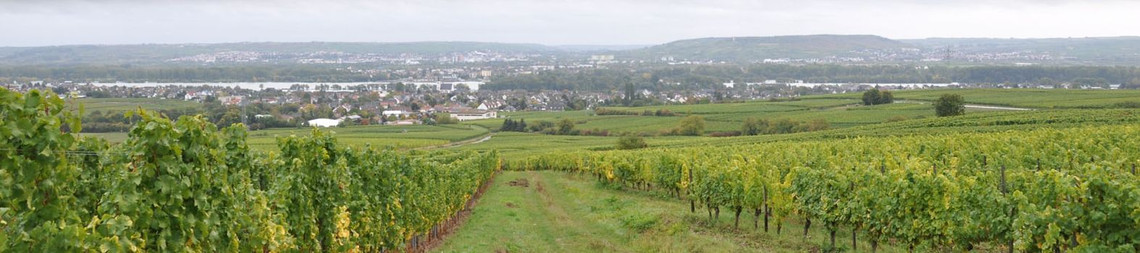
In the field-of-view of the stele you can see the vineyard sites Hasensprung and Gutenberg (left) as well as the town Winkel and the St. Walburga Church. Beyond the Rhine with its wooded point bars you can see the plateau of the Westerberg.
Enjoy this panoramic view of Johannisberg, Winkel and the Rhine.
Loess
Loess is accumulated dust from the ice ages. Storms removed fine-grained material from the river terraces and vegetation-free soils of the cold deserts. Wherever the wind speed dropped, this load was deposited creating blankets of loess up to several meters thick. Usually the light-coloured, fine-grained and calcareous sediment is hidden from view in the underground.
Loess soils a heavenly gift
The loose loess makes it easy for the roots of the vine to penetrate deep into the ground. The soil is easy to work, but is also susceptible to erosion. The excellent water retention capacity of the soil ensures that the vines are adequately supplied with water during dry periods.
Providing the microclimate is beneficial, loess soils prove ideal for winegrowing with best ripening conditions.
Vineyard sites
The vineyards of Winkel are characterised by loess soils. The deeper horizons also contain smatterings of sand, clay or gravel and, in more elevated locations, some quartzite. The fertile loess provides the vine with all it requires and more. This opulence is reflected in the wine. Wines from Winkel are expressive in aroma, juicy and display a wide range of fruit aromas that are balanced by a well-integrated acidity.
The Hasensprung (Hare Jump 97 ha) was named after the brown hare.
The vineyard Gutenberg (50 ha) has nothing to do with the inventor of book printing! It means good hill! And this refers to the good quality of the wine.
The vineyard Schlossberg (33 ha) is owned by Castle Vollrads. The wines are full-bodied with a fruity-fresh sense of acidity and hints of minerality.