



Oestrich and die Pingsdbach
Oestrich, Pfingstbach, historic settlement, Gottesthal Monastery
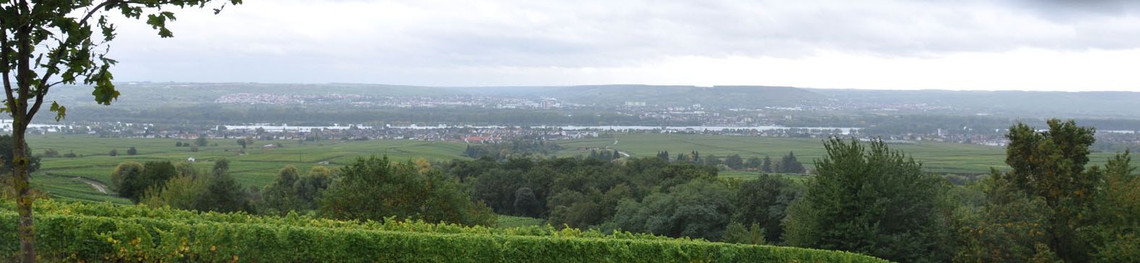
In the field-of-view of the stele you can see the forested flanks of the Dornbach valley. The Pfingstbach flows from the right and picks up the Dornbach near the former Gottesthal Monastery. The old town centre of Oestrich was built on an alluvial fan. A steep cliff stretches from the outskirts of the town to the middle terrace where the vineyards begin. The actual town of Oestrich lies further down, nearer the river, on the lower Rhine terrace.
Oestrich settlement beside the wate
The Kerbesberg offers a wonderful view of the old wine town Oestrich. The oldest relics of human settlement of the area date back to the early Stone Age (5500 to 2500 BC). Early settlements were dependant on a reliable water source. However, since floods always threatened the land alongside the Rhine, the old settlements were founded further away from the river on the alluvial fans of the tributaries. This is also the case for the old Celtic settlement Oestrich, which probably dates back to the Bronze Age.
Alluvial fans were deposited in the last ice age because the gradient of the streams and therefore their load carrying capacity decreased as they joined the Rhine. This caused the streams to drop their load of sand, gravel and debris in cone shaped mounds.
In todays moderate climate much less material is washed down from the hills and the streams carved their bed into the deposits. The alluvial fans fell dry.
The names of rivers
The names of rivers are often the oldest names we know of. But what does the name of the life-providing river of Oestrich, the Pfingstbach, have to do with Whitsun (=Pfingsten in German)? Nothing! Historically, the Pingsdbach as it is locally known, was called Vinxtbach. And Vinxt is probably of Celtic origin and means winding, or bent.
The Pingsdbach
The Pingsdbach originates in the Taunus Mountains, about 2.7 km east of Stephanshausen. At the Kornsmühle Mill, north of Castle Vollrads the stream enters the Rheingau and has carved a deep valley into the underlying rocks. This is mirrored by the Dornbach stream, whose steep flanks are covered by a dense forest.
The Dornbach joins the Pfingstbach further downstream. Then the stream passes through a landscape of gardens and grassland until it reaches the railway line. Here it is directed into a culvert where it flows under the railway line and the town until it joins the Rhine near the Oestrich Crane.
The mills along the Pfingstbach
Until recently water was also used as a power source for processing natural products (e.g. cereals, oil, oak bark, ores). The Pfingstbach provided power for up to 8 mills at a time. Most of these mills were still in operation at the beginning of the 20th century.
Gottesthal Monastery
The historic Gottesthal Monastery was located at the confluence of Pfingstbach and Dornbach. Some old walls and the gatehouse built in 1697 are all that reminds us of the Cistercian nuns who lived and worked here for nearly 600 years.
The monastery was founded in 1213 and was granted patronage over the parish and basilica St. Aegidius in Mittelheim in 1284. Duke Friedrich August von Nassau closed the monastery in 1811 (secularisation) and confiscated all properties. All buildings were demolished in 1812, apart from the gatehouse.
Vineyard sites
The vineyard Mittelheimer Edelmann (90 ha) was once owned by a nobleman (German = Edelmann). Areas dominated by deep loess and weathered loess deposits produce expressive, full-bodied wines, whereas the areas covered by shallow, gravelly soils yield wines that are lighter with a noticeable acidity.
The loess and weathered loess soils of the vineyard Oestricher Klosterberg (81 ha) are very fertile. The soils of the higher sections of this vineyard also contain quartzite. Lower down, the soils contain gravel or sand.
The wines of the weathered loess soils are full-bodied with a sense of minerality.
The vineyard Oestricher Lenchen (120 ha) is located on the steep slopes of the Pfingstbach valley. Here the vines grow on gravelly weathered loess as well as Tertiary marl soils, producing wines that are both aromatic and full-bodied.