


The Dreimärker
Dreimärker, Erbach, Marianne von Preussen, Rhine terraces
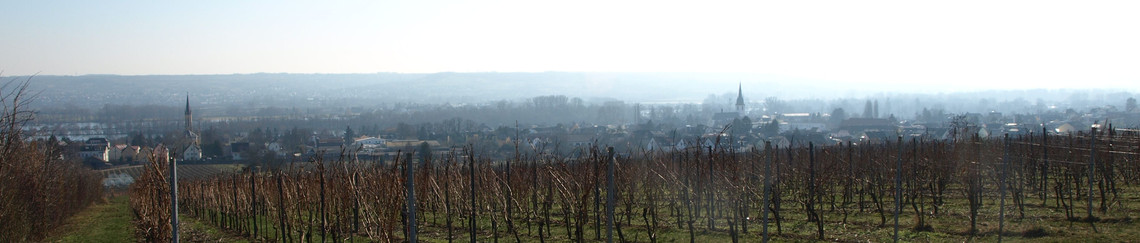
In the field-of-view of the stele you can see the edge of an old Rhine terrace. Left of the coppice is the Eltville part of the vineyard Steinmorgen. The old town centre of Erbach was built on the alluvial fan of the Eberbach, which is located near St. Markus Church. The point bar Mariannenaue lies opposite Erbach.
The Dreimarkstein - Three signs stone
marks the boundary between three parishes.
The boundaries of the three parishes Erbach, Eltville and Kiedrich still meet here today. This spot was marked with a large sandstone boundary stone with an arched top, which was stolen in 1985.
Erbach
The name is derived from the river Eberbach, which joins the river Rhine here. With time Eberbach was shortened to Erbach.
Erbach boasts several points of interest such as the catholic St. Markus Church, the protestant Johannes Church and Castle Reinhartshausen and the surrounding park.
Wine has been produced in Eberbach since Medieval times. The vineyard Marcobrunn produces world-class wines. .
On the Rhine terrace
The terrain climbs in steps from the Rhine to the Taunus Mountains. The levels surfaces that are separated from each other by steep banks are known as terraces. This step-like landform was formed by the River Rhine. The terraces are the remains of ancient floodplains into which the river carved a new bed. The terraces are the visible result of the alternation between cold glacial and warm interglacial periods. The downcutting of the river bed was intensified by the uplift of the Taunus mountains.
You are standing on the lower Middle Terrace. The slope is inclined towards the next youngest terrace on which Erbach was founded. The youngest terrace is the Low Terrace where the Rhine flows today.
Marianne von Preussen
Princess of the Netherlands was married to Prince Albrecht of Prussia. Disappointed with her marriage, she left her family in 1845. Later she met Johannes van Rossum with whom she shared an unconventional relationship. She gave birth to son, Johann Wilhelm von Reinhartshausen (18491861) and resided in Erbach. Marianne purchased Castle Reinhartshausen together with the Mönchaue in 1855. The castle was once the residence of the Knights of Erbach. Under her guidance, the castle grew into a cultural centre along the Rhine.
In 1902 the point bar was renamed Mariannenaue in her honour.
Vineyard sites
The name Steinmorgen (Erbach 18 ha, Eltville 10 ha) was first recorded in 1211. This vineyard covered an area equivalent to that, which one man could cultivate in one morning (morgen). The deep loess/weathered loess soils also contain Rhine gravel (stone = Stein).
The moderately alcoholic wines are fruity, lively with a racy, often mineral acidity.
The vineyards Kiedricher Sandgrub (69 ha) and Eltviller Sandgrub (34 ha) are recultivated sand pits, where sand was once extracted for construction purposes.
Calcareous loess/weathered loess soils cover the Middle Terrace of the Rhine. Local occurrences of sand and gravel are also typical for this landform. This variety of soils is reflected in the diversity of wines. Calcareous locations yield wines with a balanced acidity that is embedded in the aroma.
Floodplain soils of the Mariannenaue.