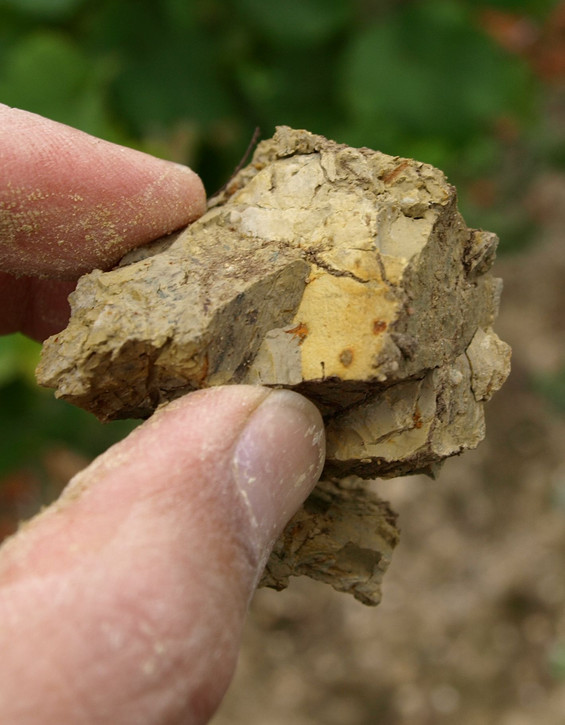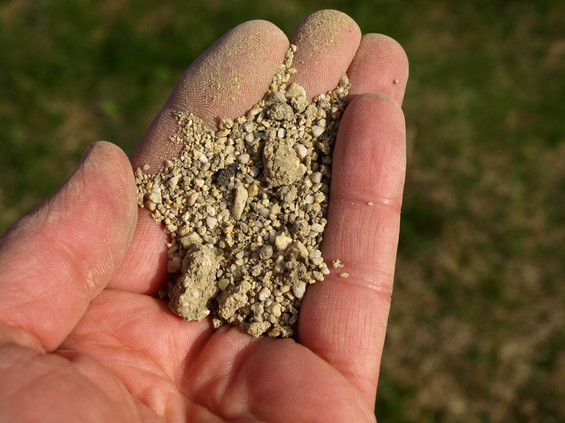


The Schönhell
Schönhell, marine sands, geo-resources
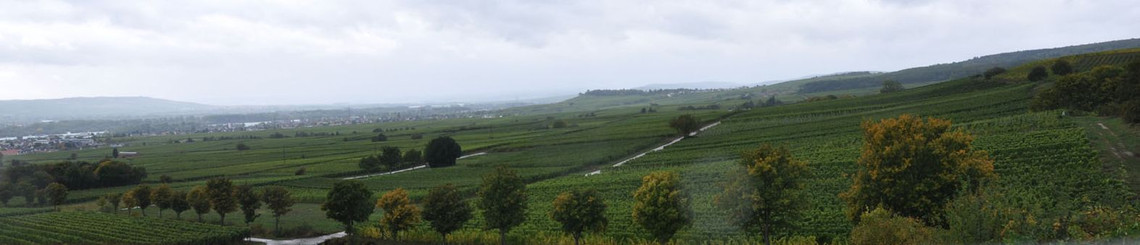
In the field-of-view of the stele you can see the vineyard Schönhell. The wine-growing communities are located on the younger Rhine terrace, the vineyards are located on the older terraces. The hills on the right were uplifted simultaneously with the Taunus Mountains.
Hard rocks (Johannisberg) or geological faults (Vollrads) form prominent scarps in the landscape.
Schönhell
The Schönhell is the oldest vineyard in Hallgarten, first officially recorded in the 14th century. Helle, Helde or Hölle is derived from the Old High German word Halda for mountain slope. There are many old vineyards names that can be traced back to this word: Wieshell, Rheinhell, Hölle, Nonnenhöll, Höllenberg. The name beautiful slope is fully justified for the gentle hills of the Schönhell.
Places of devotion beside the road
There are several interesting chapels and historic field monuments in the Hallgartener Schönhell. Most of these sculptures and depictions have been carved from sandstone. These monuments are a testimonial to the piety of the people.
The construction of the wayside crosses always follows a similar pattern: they consist of a pedestal, the cross and corpus.
Coastal sand
The layers of gravel and sand found along southern edge of the Taunus Mountains were deposited along the coast of an ancient ocean. Where did they come from? During the Oligocene (30 million years ago) the formation of the Upper Rhine Rift Valley created a temporary marine connection between the open seas in the North and South. The Mainz Basin was also flooded.
The Taunus Mountains formed the coastline of this sub-tropical sea where sharks and sea cows swam. The Central Rheingau is full of evidence of this ancient sea: beach shingle and sands (Marine sand) non-calcareous (Rupel clay) and calcareous clays (Cyrenia Marl, Schleichsand).
The continuing uplift of the Taunus Mountains elevated the sediments to different heights.
The hills of the vineyard Hallgartener Schönhell are composed of coarse, quartz-rich sands. They were deposited in a dynamic, near-coastal area, maybe forming the beach of the Tertiary Sea.
Sandkauter Wiesen
The Sandkauter Wiesen is a recultivated abandoned sand pit where marine sands were extracted as a construction material. Local geo-resources were exploited in the Rheingau as well: rocks, loose deposits, lignite, alum, Kaolinite and iron ores.
Limonite and clay was mined from 1875 to 1885 in the open cast mines Wolf and Jägerborn in the vineyard Würzgarten in Hallgarten. Later these pits were levelled and recultivated. Today this site is a refuge and biotope for many animals.
Sandkauter Wiesen
The texts carved into the pedestals are often taken from the old and new testament or from hymns. The inscriptions reveal the date of construction and the donor either alone or together with his wife.
Vineyard sites
The main soil types of the Hallgartener Schönhell (48 ha) are shallow gravels, light sands to heavy weathered loess and clays. Such a variety produces diverse wines ranging from light wines with a pronounced minerality (sand and gravel) to full-bodied wines that are expressive, (clay) and with a pronounced sense of fruit (weathered loess).
The vineyard Oestricher Lenchen (120 ha) is dominated by deep, partially gravelly loess/weathered loess soils as well as heavy marl soils. The aromatic, full-bodied wines have a pleasing bouquet.
Different soils mean more varieties of wine: