



Glacial periods, ice wedges and loess
Land between the glaciers
There were no glaciers here along the Rhine during the ice age. Lorch was situated in a so-called periglacial environment. It was extremely cold, especially during the winter. The alternating cycles of freezing and thawing shattered the rocks (frost weathering). However the deeper subsurface was permanently frozen (permafrost).
Sliding downhill
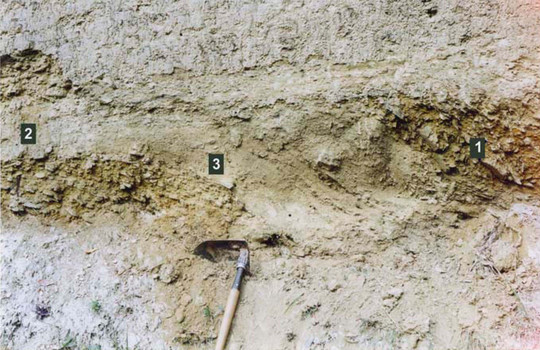
The wall in front of you consists of light coloured silt. This is the loess, a dust deposited by wind. Huge blankets of loess were deposited on the valley slopes along the Rhine and Wisper, during the last glacial period about 20,000 years ago. During the summer, the frozen surface soil thawed. It only took a slight incline cause this water saturated mud to slide downhill. All lower vineyard locations in Lorch are located on the redeposited loess from these mud slides.
Ice wedges as a witness to histiry
The light coloured loess covers dark brown sediment. This is gravel that was deposited here by the stream that preceded the Wisper. The material has weathered to form a brown soil. Such soils developed during the interglacial period. The loess was deposited here when the climate cooled once more and the area was covered with permafrost. The subsoil was permanently frozen. Ice wedges formed in the frozen soils. These are cracks filled with pure ice. When the climate warmed again, the ice wedge thawed and the overlying light-coloured loess collapsed into the open crack, forming a so-called ice wedge cast.
Loess a gift from the heavens
Loess soils are the best agricultural soils in Germany. Loess contains a large proportion of weathered silicates and calcium carbonate. The sediment consists of silt, which describes particles from 0.02 to 0.0063 mm in diameter. These form tight pores, which can hold large amounts of water. This is why loess is so fertile. The calcium carbonate in the loess binds the mineral particles like cement. This allows the loess to form stable banks. Without the calcium carbonate the bluff in front of you would collapse.