



The Bubenhäuser Höhe
Mainz Basin, Tertiary sea, limestone
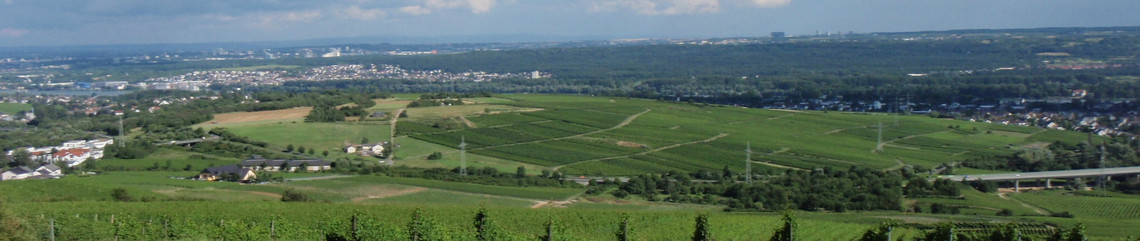
In the field-of-view of the stele you can see the plateau of the Grossen Hub. Geologically, this belongs to the Marl Tertiary of the Mainz Basin. Below, where the plateau meets the steep slope, is the edge of the Mainz Basin. The Taunus Mountains were uplifted along a series of faults. Beyond the Rhine lies the Plateau and Hill Landscape of Rheinhessen.
Long ago on the beach
Limestone and marls dating back 25 to 15 million years ago form the upper slopes of the northern Mainz Basin. They were deposited in a sub-tropical marine environment, a shallow sea. The Mainz Basin is more or less identical with the region Rheinhessen, but in the north, it reaches across the Rhine into the Rheingau. The geological situation of the Mainz Basin during the Tertiary is comparable to that of the present coastal areas of North Florida with their white flat beaches.
Rheinhessen and the Rheingau would have been an ideal destination for surfers and swimmers had Man been around back then.
The Bubenhäuser Höhe
The geology of this hill makes it unique in the Central Rheingau. The top of the hill is composed of limestone. The vineyard soils contain limestone debris. This 20 million year old limestone was uplifted together with the Taunus Mountains. This is the only place where this rock has been preserved.
Limestone and marl
A vast number of different marine animals thrived in the sub-tropical sea 30 million years ago, including 28 species of shark and rays.
The limestone and marl was formed in the sunlit shallow waters of a sub-tropical sea. The rocks contain fossils such as tower shells, tiny mudsnails or shallow water molluscs. Dry and hot periods alternated with humid and warm climatic phases, during which mud was transported into the sea by rivers from the mainland. When deposited, this mud formed Limestone marls (limestone with a significant clay content) and marls (calcareous clays).
From the Primeval Rhine to the present landscape
The sub-tropical sea of the Mainz Basin receded once and for all around 15 million years ago. Then, about 5 million years later, the primeval Rhine began to flow through the Mainz Basin.
The landscape as we see it today was actually shaped during the ice age which ended around 12,000 years ago.
Vineyard sites
The vineyards Rauenthaler Langenstück (24 ha), Gehrn (17 ha) and Wülfen (15 ha) as well as Rothenberg (20 ha) on the left are all located below the crest of the Bubenhäuser Höhe.
The soils of the Langenstück contain Phyllite and weathered loess. However, the higher parts of the vineyard consist of limestone and clay marl. Because of the elevated location of the vineyard, the wines possess a light aroma and nervy to tart acidity and appear both harmonious and balanced.
The name Gehrn is derived from the Middle High German word Giern = spearhead, which describes the shape of the vineyard. The deep weathered loess and Phyllite soils produce wines with a pleasant interplay between distinctive aromas and mineral acidity.
The wines produced in the vineyard Wülfen are full-bodied with a nervy acidity.
Landscape history
The Tertiary Period around 30 million years ago:
The Mainz Basin is flooded by a sub-tropical sea. A vast number of marine animal species live here (sharks, rays, bony fish, sea cows, balanids, molluscs, snails, etc.)
Around 26 million years ago the sea recedes from the Mainz Basin
Around 25 million years ago renewed flooding by the sea, deposition of calcareous muds. Formation of the rocks of the plateau mountains.
Around 15 million years ago
Final retreat of the sea from the Mainz Basin; the exposed rocks begin to weather and erode.
The Quaternary Period begins around 2.6 million years ago: Deposition of loess during the ice ages. Rivers and streams downcut into the underlying rocks, valley formation and creation of the present-day landscape