



The Mills of the Elsterbach valley
Elster Valley, mills, Monastery of Johannisberg
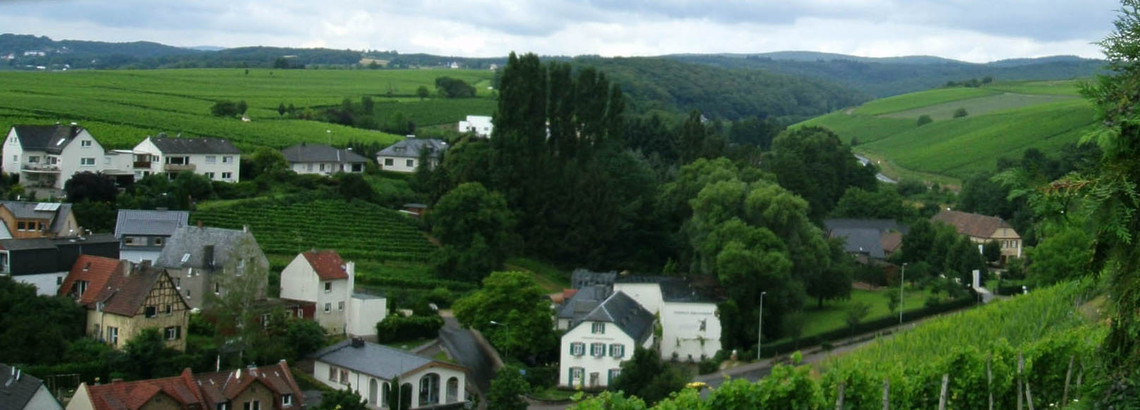
In the field-of-view of the stele You can see the entrance of the Elsterbach Valley near Johannisberg-Grund. The Elsterbach river winds its way through the Taunus Mountains in a valley it carved into the old peneplain as the landscape was uplifted. The peneplain itself is covered by the terrace deposits of the ancient Rhine. The warm, south-west facing, steep wall of the valley is used for wine-growing.
Mills of the Rheingau
For centuries mills played an important role in everyday life. Once there were up to 100 water mills in the Rheingau, of which only 30 were still running at the beginning of the 20th century. In most cases the mills were either owned by the nobility or monasteries.
Usually the miller leased the mill in perpetuity. There were many different types of mill: gristmills, oil mills, saw and paper mills, tool sharpening and forge mills as well as bark and fulling mills. From the 14th century onwards, most mills were driven by an overshot wheel, where water is brought to the top of the wheel.
Our daily bread
Cereal production in the Rheingau has always been less than the actual demand. The gristmills provided the population with sufficient amounts of flour, grist, pearl barley, semolina and oat flakes.
Mills along the Elsterbach
The source of the Elsterbach lies near Stephanshausen in the Taunus Mountains and joins the Rhine at Winkel. The river provided power to drive at least 14 mills. In most cases it is not known when the mills were built, official records mentioning the mills date back to the 14th century. The chain of mills begins with the Marienthaler Klostermühle, followed by the Waldmühle, Schleifmühle, Reussche Mühle, Ostermühle, Weihermühle, Elstermühle, Schamari mill, Brückenmühle, Krayersche Mill, Vattersche Mill, Mühle an der Klaus, Ankermühle, Weissmühle and Pforzheim Mill. The last mill before the Elsterbach joins the Rhine is the Zwickmühle.
As the old German folksong says: Roving is the millers delight
Every one of the historic mills makes a wonderful destiny for walking.
The self-guided tour of the mills, the 5 km long circular route Johannisberg Mill Trail, begins at the Estate Johannishof. Food and drink is available in taverns found in the mills.
Kilzberg
marks the place where charcoal was produced in clamps when this area was still forested.
Johannisberg
Johannisberg is a manorial settlement of the Monastery of Johannisberg, which was founded at the beginning of the 12th century by the Benedictine Order. The community is named after the monastery. The history of the mills is closely linked to the monastery. Thus the Schamari-Mill is first officially recorded in connection with the downfall of the Order, when it was sold for 20 Guilders to squire Knebel from Katzenellenbogen.
The monastery was dissolved in 1563.
Steep slopes, stony soils the vineyard soils in Johannisberg.
Vineyard sites
The slopes of the Elster Valley are covered by stony, coarse, reddish quartzite soils. The steepest slopes are found in the First Growth vineyard Johannisberger Mittelhölle (6 ha). The wines are delicately fruity with a noticeable sense of acidity. The soils of the upper, less steep vineyard Johannisberger Hölle (18 ha) have developed on weathered loess as well as river terrace gravel deposits. The soils are moister and more fertile and therefore produce expressive, long and highly elegant wines
The vineyard Geisenheimer Kilzberg is covered by deep loess and weathered loess deposits as well as terrace gravels. The wines are full-bodied with a well-balanced acidity.