



Ice wine
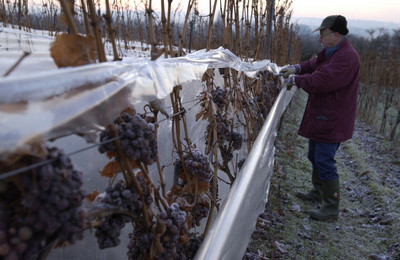
In some years the wine grower’s patience is rewarded by valuable rarities! Stakes are high when wine growers take a risk. At stake are grapes that are left on the vine longer than usual and which are exposed to the merciless temperatures of the approaching winter.
This game with Mother Nature can go on until January, in rare instances, until February. For wine growers, this is an all-or-nothing venture since the gamble involves the risk of a total loss of the unpicked grapes. On average, only about ten per cent of the original crop actually end up as Eiswein. The remaining grapes are harvested selectively or succumb to the variable weather conditions.
A Vintner’s Masterpiece
The actual Eiswein harvest, often in the wee morning hours, is a strenuous task. The frigid temperatures leave fingers stiff and painfully sore. Picking the frozen grapes is laborious, and in the end, yields a mere three to five hectolitres per hectare. The wine is produced as a rarity from the very beginning and calls collectors into action. These noble growths have their price, but the few bottles that are produced are quickly sold out.
The Grapes Must Freeze on the Vine
In contrast to the other noble sweet wines such as “Auslese”, “Beerenauslese”, and “Trockenbeerenauslese” the Eisweins’ secret is in their dense concentration of the ingredients of the grapes and a relatively high acidity. A phenomenon that happens when the grapes freeze while still on the vine. Temperatures of at least -7°C are necessary for the grapes to be picked, temperatures ranging from -10 to -12° C are ideal. At the break of dawn (or earlier) the naturally frozen grapes are picked and pressed immediately, while still frozen. The water content of the grapes remains as a block of ice in the press and only the very sweetest juice of the grapes, whose freezing point is lower than that of water, is extracted as highly concentrated must.
Eiswein Doesn’t Happen by Accident
Wine growers cannot squeeze out much from the frozen rock-hard grapes, quality reigns over quantity. This requires some preparation and special commitment on the part of the wine grower, since Eiswein doesn’t happen by accident. A strict, tight, quality management in the vineyard and special cultivation actions through the entire growing season are prerequisites for a superb Eiswein.
When the grapes are fully ripe, the parcels devoted to Eiswein production are partially defoliated and wrapped in protective foil. It protects above all against hungry birds and was first introduced in the 60’s. Without the protective foil, it would be impossible for the grapes to remain on the vine until December or even January. The protective foil does not bring about climatic changes as is often claimed.
A Superb Eiswein Requires Healthy Grapes
Ardent Eiswein wine-producers meticulously look for healthy grapes that have not been attacked by botrytis, the fungal disease responsible for noble rot. The grapes for making a truly great Eiswein should be as healthy as possible. Herein lies the difference in flavour between Eiswein and other noble sweet wines, such as “Beeren”- or “Trockenbeerenauslese”. A high-quality Eiswein does not have the characteristic flavours associated with noble rot. The healthy condition of the grapes for Eiswein ensure fresh, concentrated fruit flavours and the wines usually have a relatively stable acidity. As such, they are enjoyable even in their youth.
The Crowning Touch to a Culinary Feast
Although it sounds far-fetched at first, Eiswein served with ripe, blue-veined cheese is an interesting combination: on the one hand, there are the salty to slightly bitter notes of the creamy cheese; on the other hand, the fruity, sweet aromas of the concentrated wine that envelop the tongue and palate and add up to an exceptional taste sensation.
(Source: German Wine Institute, www.deutscheweine.de as of 5 July 2011)