



Slate and Co
The typical rock of the Middle Rhine is slate. A whole landscape was named after this rock: Rhenic Slate Mountains .
However, these mountains offer more than just blue-grey slate. The rocks around Lorch, include slate in various shades, quartzite, sandstone, basalts and tuff as well as loess and gravel. The slate was mined for roofing tiles in Lorch and there was also once an iron mine.6.
Metamorphosis rock transformation
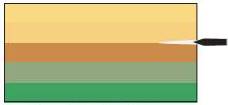
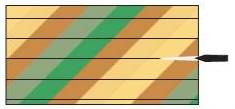
Slates are fine-grained rocks, that are easy to recognize with their typical foliated structure. This foliation develops in shale under the influence of pressure and heat at several kilometres depth. Normal pressure at that depth is caused by the weight of the overlying rocks. However, to produce foliation the rock must be subjected to directed tectonic pressure, which occurs when mountain ranges are formed. The Rhenic Slate Mountains were formed by the deformation of marine sediments. Subjected to great pressure and temperatures, the minerals in the shale recrystallized and realigned themselves in a process called metamorphism.
Flattened slate consist of thin layers of platy minerals
Slate is composed of sheeted elastic minerals such as clay minerals, mica and chlorite. Exposed to pressure, these minerals will realign themselves at right angles to the strain, resulting in the typical foliation of the rock.
The rock is easily spilt along this cleavage plain. The higher the clay content of the parent rock, the better the cleavage. Roof slate is a pure slate with an excellent cleavage.
The rocks of Lorch
Hunsrück slate
The dark slates are also called HUNSRÜCK SLATE. This is a marine mud turned to stone. During the Lower Devonian (approx. 417-400 Million years ago), this region was covered by a sea, the so-called Rhenic Basin. Mud was deposited here in a continuously sinking basin. The resulting accumulation of the sediment was several thousand meters thick. Due to the extremely high pressure of the overlying sediments the mud was slowly transformed to siltstone and shale.
During the Lower Carboniferous (359-328 million years ago) the rocks were deformed during large-scale mountain building processes. However, the rock does not just consist of silt. Plants and animals thrived in the ocean. Their remains are sometimes found as fossils. Mostly, all that is left of them is a fine coaly, organic constituent, which stains the rock grey-blue.
Taunus quartzite
Quartzite is a metamorphic rock with a high quartz content (up to 98%). Quartz-rich marine sands were deposited in moving water and deformed during the Carboniferous Period. The mineral quartz (SiO2) is colourless. Yellow and red colours are the result of tropical weathering of the rock during the Paleogene and by the influx of other substances, for example iron.
Quartzites are massiv rocks and are not foliated. During metamorphosis, the sand grains recrystallized and the pores were filled with quartz. This is why quartzites are such extremely hard rocks and very resistant to weathering. In the Middle Rhine Valley, the steep locations are formed by quartzite, for example the cliffs. The quartzite landscape looks wild and rough.
Life in the Hunsrück Sea
During the time of the Hunsrück Slate Sea, plants were only just beginning to conquer the land. Nearly all life was found in the water. Today, the animal remains that were embedded in the mud tell us what life was like during this time. The fossils found in the slate mine Kreuzberg show lifeforms from the deep ocean, far away from the coast.